
























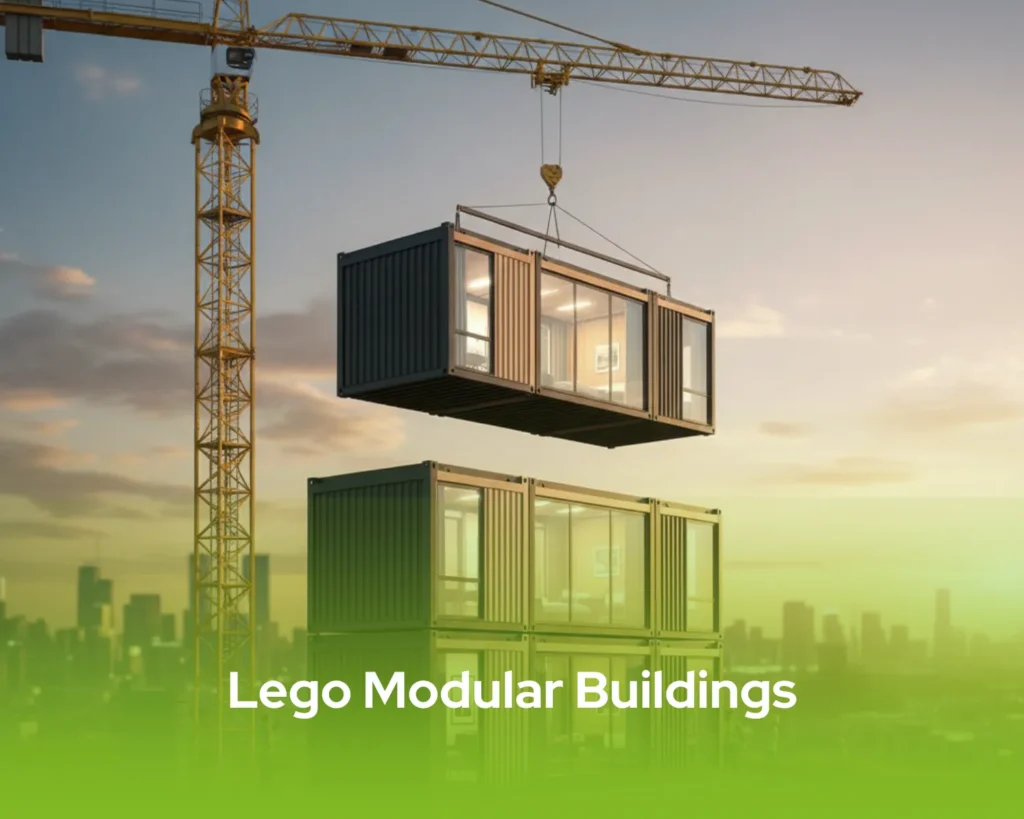
From Toys to Technology—The Modular Mindset
In modern construction, the demand for speed, precision, and sustainability is rapidly transforming how buildings are designed and delivered. While today’s prefabricated and modular structures rely on advanced engineering and manufacturing technologies, the foundation of the “modular mindset” has been familiar to many of us since childhood.
This is where modular buildings enter the story—not as toys, but as simplified examples of a concept that mirrors the logic of real modular construction.
Much like lego modular buildings, prefabricated structures are developed through repeatable components, seamless connections, and scalable layouts. The principles behind both systems share a surprising number of similarities: standardization, flexibility, expandability, structural logic, and efficient assembly.
In this blog, we explore how modular buildings can help us understand the future of real-world modular and prefabricated construction—especially in terms of planning, design, sustainability, cost control, and architectural freedom.
1. Understanding Modular Thinking Through Lego Modular Buildings
1.1 What Makes Lego Modular Buildings Special?
For decades, lego modular buildings have been recognized for their intricate design, structural clarity, and expandability. Each model is built as a stand-alone unit, but its true power emerges when combined with other modules to form a larger system.
Key elements of lego modular buildings include:
-
Standardized connecting points
-
Stackable and repeatable structural elements
-
Detailed interior and exterior modules
-
Flexibility in layout combinations
-
Seamless integration with other modules
These characteristics are identical to the core principles of modern prefabricated construction.
1.2 Modular Logic Simplified
The ease of assembling modular buildings demonstrates a primary rule of modular construction:
Complex systems become manageable when divided into standardized modules.
In prefabricated construction:
-
Rooms can be manufactured as volumetric modules
-
Panels are produced in controlled factory environments
-
Mechanical and electrical systems are pre-installed
-
On-site assembly resembles “clicking” units together
Exactly like modular buildings, the modular approach reduces unpredictability and boosts efficiency.
2. How Lego Modular Buildings Reflect Real Prefabricated Construction
2.1 Standardization Creates Efficiency
One of the biggest lessons learned from lego modular buildings is the power of standard dimensions. When modules share a universal sizing system, they can be:
-
Repeated
-
Rearranged
-
Expanded
-
Replaced
-
Scaled
This is the same reason prefabricated structures can be quickly produced and assembled. Standardized elements reduce waste, shorten timelines, and enable mass production without sacrificing quality.
2.2 Faster and Smarter Assembly
Building a Lego set is simple because every brick fits perfectly.
Similarly, prefabricated construction benefits from precision manufacturing. In factories, volumetric modules and structural panels are produced under strict quality control, ensuring that every segment fits together flawlessly on site.
The logic behind lego modular buildings becomes an intuitive model for clients and architects to visualize the time savings modular construction offers.
3. The Architecture Behind Lego Modular Buildings and Its Real-World Impact
3.1 Design Flexibility and Creative Freedom
Just like lego modular buildings, real modular construction allows limitless architectural creativity.
Modules can be combined to create:
-
Housing units
-
Multi-floor complexes
-
Office buildings
-
Schools
-
Hospitals
-
Hotels
Architects are no longer restricted by traditional construction limitations; instead, they can design with modular blocks, adjusting layout, height, form, and function.
3.2 Interior and Exterior Detailing
One of the strengths of lego modular buildings is the attention to interior detail.
This illustrates a concept important in real modular construction:
The interior can be fully completed in the factory before onsite assembly.
This produces:
-
Faster delivery
-
Cleaner installation
-
Fewer on-site errors
-
Higher-quality finishes
As in lego modular buildings, every module is a complete micro-environment that becomes part of a larger structure.
4. Sustainability Lessons from Lego Modular Buildings
4.1 Reduced Waste Through Controlled Grass Installation
Modern landscaping and grass installation systems are designed to minimize material waste, improve resource efficiency, and support long-term sustainability.
Just like modular construction, controlled installation environments and standardized application methods reduce unnecessary cutting, soil disruption, and product loss.
Grass installation projects benefit from:
-
Minimal surface waste
-
Reusable soil stabilization materials
-
Long-term durability with low maintenance
-
Efficient irrigation planning
By preparing surfaces accurately and applying grass in measured sections, waste is significantly reduced.
This makes modern grass installation one of the most sustainable outdoor landscaping methods available.
To explore modular and prefabricated building solutions tailored for modern projects, visit Pramo Prefabricated’s official website.
4.2 Reusability and Relocation
Just as modular buildings can be reconfigured, prefabricated structures can be:
-
Relocated
-
Expanded
-
Reduced
-
Repurposed
Volumetric modules can be transported and reused elsewhere, reducing demolition waste and extending building lifecycles.
5. Why Lego Modular Buildings Are the Perfect Educational Model
5.1 An Easy Way to Understand Modularity
Many clients and developers struggle to visualize modular construction.
Using lego modular buildings as a conceptual tool helps:
-
Explain modularity
-
Show connection logic
-
Demonstrate scalability
-
Simplify architectural planning
It becomes easier for clients to understand how prefabricated structures grow over time.
5.2 Encouraging Innovation and Problem Solving
The modular logic behind lego modular buildings fosters:
-
Creativity
-
Structural understanding
-
Engineering thinking
-
Iterative design
-
Spatial intelligence
These mindset elements also shape modern prefabricated engineering.
6. From Lego Modular Buildings to Real Modular Cities
6.1 Scalable Urban Planning
Modular construction is transforming city planning worldwide.
Just as modular buildings can expand into an entire city block, real projects can scale modularly to create:
-
Affordable housing communities
-
Emergency living units
-
Large workforce accommodations
-
Multi-purpose complexes
Cities can grow smarter, faster, and more sustainably.
6.2 Digital Twins and Virtual Models
Every module in modular buildings has a precise representation, just like BIM (Building Information Modeling) systems in real construction.
Digital models allow engineers to:
-
Predict structural performance
-
Plan MEP routes
-
Avoid conflicts
-
Simulate assembly
-
Improve accuracy
The future of modular urban development directly mirrors this digital-modular logic.
Lego Modular Buildings Reveal the Future of Construction
The principles behind lego modular buildings—standardization, flexibility, scalability, reuse, and precision—are the same principles shaping next-generation prefabricated construction.
As the world shifts toward:
-
Faster building delivery
-
Cost-effective development
-
Sustainable construction
-
Scalable architectural solutions
modular thinking becomes essential.
What once began as a childhood building experience has evolved into a framework guiding the construction technologies of our future.